

By Neda Jahanbani
On June 17, U.S. President Donald Trump and Iranian President Masoud Pezeshkian signed a 14-point Memorandum of Understanding that ends hostilities and lays the framework for talks on a comprehensive deal. Both sides have committed to immediately start some actions, such as reopening the Strait of Hormuz and lifting the U.S. blockade. But other provisions, such as the complete lifting of sanctions on Iran and longer-term limits on its nuclear program are contingent on negotiations during the following 60-day period. In early July, the talks hit a stumbling block amid renewed fighting, but both sides appeared reluctant to return to full-scale war.
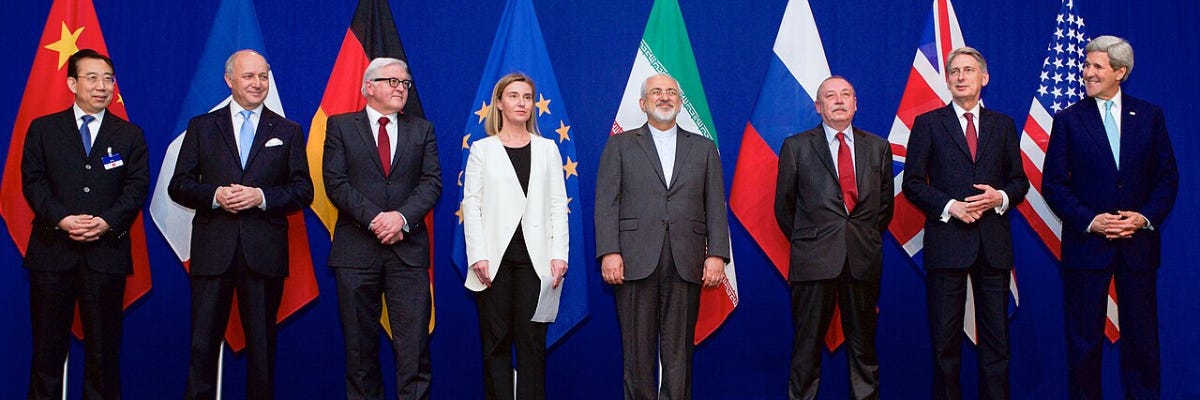
The legacy of the landmark 2015 nuclear deal, which took two years to broker, looms over the new round of U.S.-Iran diplomacy. Examining the formal structure and the assumptions behind the Joint Comprehensive Plan of Action (JCPOA) as well as how the deal unraveled, offers useful lessons for the new U.S.-Iran talks.
The JCPOA was underpinned by the U.N. Security Council (UNSC) system, which was initially an asset but ultimately became a vulnerability. The veto power held by the council’s five permanent members — China, France, Russia, the U.K., and the U.S. — has been a source of tension since its inclusion in the body’s 1945 charter. A typical UNSC resolution must receive nine votes in favor and no vetoes from any permanent member to pass. The system relies heavily on multilateral cooperation but can be easily upended by unilateral action. Great powers have consistently used the veto to assert their dominance, most aggressively during the Cold War.
The veto system initially posed an engineering problem to negotiators from the five permanent UNSC members and Germany, the P5+1, in 2015. If Iran were to violate the nuclear deal, reimposing sanctions would require a new resolution, which could be vetoed by either of Iran’s allies and permanent UNSC members, China and Russia. The Western powers sought a fail-safe enforcement mechanism that would not hinge on Chinese and Russian cooperation.
The Hair-Trigger Fix
The solution was a kill-switch that could quickly reimpose sanctions on Iran, colloquially called the “snapback.” The mechanism was embedded in UNSC Resolution 2231, which endorsed the JCPOA. The snapback was designed as a reverse-engineered UNSC resolution. If any of the P5+1 countries initiated the process, nine votes would be needed to stop it, a deliberate inversion of the UNSC’s typical framework. Once triggered, the mechanism would give the parties 30 days, a diplomatic buffer zone, to reach an agreement in the case of “significant non-performance” by Iran. If no resolution was reached within 30 days, all nuclear-related U.N. sanctions would be automatically reimposed.
The snapback appeared to be an ingenious work-around to the UNSC resolution system. It eased fears that the nuclear deal relied too excessively on long-term trust in a government known to be hostile to the Western powers leading the talks. Negotiators, however, did not account for the possibility that a member of the P5+1 would become the violator, which is precisely what happened when President Donald Trump unilaterally withdrew from the JCPOA in 2018 and reimposed U.S. sanctions on Iran under the “maximum pressure” campaign. These moves did not formally dissolve the deal, but they left Iran bound by its obligations while being squeezed out of the world economy.
Snapback Disputes
The first highly public stress test of the snapback came in 2020, when the U.S. tried to reimpose U.N. sanctions, citing its standing as a “JCPOA participant State” and Iran’s “significant non-performance.” UNSC members blocked the effort, maintaining the mechanism’s integrity. But the attempt created disorder and revealed critical ambiguities. Who counted as a “participant state” with the standing to trigger the mechanism? Did the rules of the snapback still apply if one of the P5+1 countries failed to comply with the deal?
Under the JCPOA’s terms, October 18, 2025 was the deadline to initiate the snapback, setting the stage for another test of the mechanism. On August 28, 2025, the E3 (France, Germany, and the U.K.) notified the UNSC that Iran was in significant non-performance of its JCPOA commitments, beginning the 30-day period for consultations.
Representatives from Iran, Russia, and China immediately challenged the E3’s standing to invoke the mechanism at all, raising the same objections that had surfaced in 2020. They argued that the E3, much like the U.S. five years prior, had effectively undercut the deal by failing to fulfill their own obligations and therefore lacked the legal standing to trigger the mechanism. Ultimately, the continuation resolution was not adopted.
The proverbial rubber band, its tension built up over a decade, officially snapped back on September 27, 2025, reimposing all U.N. nuclear sanctions on Iran. The mechanism worked as designed: no vote was required and no unilateral veto was possible. Once again, however, the snapback’s flaws were exposed. The reimposing of sanctions on paper and enforcing them in practice proved to be two distinct issues, especially in a global environment increasingly shaped by conflict.
Before the JCPOA, the U.N. 1737 Sanctions Committee and its associated Panel of Experts had supervised sanctions on Iran. Both ceased functioning once the deal was implemented in 2015. After the snapback mechanism was triggered in 2025, UNSC members contested the legal status and authority of these institutions.
Russia and China had seen this ambiguity as a possibility. Unable to veto the snapback procedurally, they shifted strategy and challenged the legitimacy of the mechanism itself and those enforcing it. They argued that the restored institutional framework, including the revived authority of the 1737 Committee, lacked legal validity because the snapback had not been lawfully triggered by the E3. Russian and Chinese representatives also maintained that all sanctions relief became permanent on October 18, 2025, when UNSC Resolution 2231 was originally set to expire. They contended that the council had already concluded its consideration of the Iranian nuclear issue and therefore could not lawfully restore the sanctions regime.
Russia also implicitly questioned the role of the International Atomic Energy Agency, the U.N. nuclear watchdog, in verifying Iranian compliance with the JCPOA. As Iran suspended inspectors’ access to key nuclear facilities, severely limiting the agency’s ability to conduct routine monitoring, Russia dismissed IAEA findings of Iranian violations as a “matter of interpretation” and blamed the U.S. for exiting the deal in the first place.
The snapback was a major achievement in international diplomacy that served, for a time, as a work-around to a system built to optimize multilateral cooperation. But the mechanism was conceived during a far less tumultuous period than 2026. As U.S.-Iran negotiations proceed amid continued threats of war, the collapse of the JCPOA is a reminder that even well-crafted diplomatic mechanisms are vulnerable when the legitimacy of the system enforcing them is open to contestation.
Reimagining Enforcement
Durable enforcement of a new deal requires a more comprehensive assessment of the negotiating parties. Both negotiators and mediators need to account for scenarios in which Iran and/or the U.S. violates or departs from the agreement; how the deal is codified into each party’s legal system, not just the international order; who holds standing to invoke enforcement and under what conditions; and lastly, a clear path forward for enforcement if this deal were to collapse as its predecessor had. These are difficult tasks, even if the 60-day period is extended, but negotiators can get ahead if they study the assumptions and loopholes that led to the JCPOA’s failure.
A new agreement should include an automatic, symmetrical trigger mechanism to hold both states accountable. This would allow the U.S. to secure its stated goal of a non-nuclear Iran, while the Islamic Republic could enter the agreement on more stable and neutral ground compared to the JCPOA. With this type of mechanism, the consequences for Iranian violations would remain consistent with the first nuclear deal: suspended sanctions relief, the reimposition of nuclear-related sanctions, and heightened verification measures. Comparable penalties for the U.S. should include: the automatic partial release of frozen Iranian assets and the expansion of sanctions relief for Iran in the case of a U.S. attempt to unilaterally withdraw from the new agreement. The JCPOA might have survived if enforcement had not been so one-sided. Reciprocal enforcement, however, reduces the risk of the deal unraveling. It also strengthens confidence that compliance will be assessed according to agreed-upon rules and insulated from shifting geopolitical circumstances.
Neda Jahanbani is a doctoral candidate in the Communications Program at the Columbia University Graduate School of Journalism. She is researching the historical evolution and rhetoric regarding U.S. sanctions on Iran through a constructivist lens.
Section: (all-articles) Photo: Wikicommons