

Blockading Iran Could Cause Havoc in the Global Economy
Iran is likely to retaliate by targeting commercial vessels.
By Esfandyar Batmanghelidj
“A massive armada” is heading to Iran according to President Trump, who warned that “time is running out” for Iranian leaders in a social media post. The Trump administration has evidently given an ultimatum to Iran, demanding talks over the country’s nuclear program, among other issues. If Iran does not comply, Trump has promised that the armada will “rapidly fulfill its mission, with speed and violence.” He explicitly compared Iran’s situation to that faced by Venezuela in advance of the extraordinary operation to capture Venezuelan leader Nicolás Maduro.
In the lead-up to that operation, the United States imposed a naval blockade on Venezuela, intercepting oil tankers in an attempt to squeeze the Venezuelan economy. Some analysts have come to expect that the United States will impose a similar blockade on Iran in an attempt to create an acute economic crisis, which, along with a limited military intervention, would either see the Islamic Republic make far-reaching concessions or be ousted from power.
Iran has been significantly isolated from the global economy since the reimposition of “maximum pressure” sanctions by the Trump administration in 2018. But the country’s economy has not collapsed, in part because Iranian authorities have managed to circumvent sanctions. Today, Iran is producing as much oil as in the pre-sanctions period, with production having averaged around 3.3 million barrels per day in 2025. Around half this volume is sold to refineries in China. Traditional sanctions enforcement has failed to stop these flows, which is why a naval blockade may be appealing to Trump administration officials, who are eager to impose their will on Iran.
The blockade of Venezuela had virtually no impact on the global economy. Commercial vessels transiting through the Panama Canal could easily avoid the Venezuelan coast, and the Venezuela military lacked the ability to strike at vessels in response to the U.S. blockade, limiting the potential for escalation. But undertaking a blockade of Iran presents a very different challenge and Trump administration officials should not underestimate the likely disruptions to the global economy.
While Iran boasts just two major ports, Bandar Abbas and Bandar Imam Khomeini, and one major oil terminal, Kharg Island, any attempt to block vessel traffic to and from these locations will necessarily spill over into the narrow and congested shipping channels of the Persian Gulf. Not only are these shipping channels the conduit for one-fifth of global petroleum liquids and natural gas supplies, but container traffic flowing through the Gulf is also critically important for the economies of the Middle East and Central Asia, which together account for more than 5% of global economic output.
Asymmetric Retaliation
There are two ways in which the U.S. could enforce a blockade. It could seek to place its vessels in close proximity to Iran’s ports, blocking Iranian trade while minimizing disruptions to maritime traffic in the Gulf. But doing so would expose U.S. forces to potential attacks, requiring a much more extensive force posture and increasing the likelihood that the blockade escalates into a direct military confrontation. The second option is for the U.S. to enforce a blockade by interdicting ships far away from Iran’s coast, for example by boarding vessels in the Arabian Sea, thereby keeping U.S. sailors out of harm’s way.
A 2019 assessment of Iran’s military capabilities by the Defense Intelligence Agency notes that Iran’s “swarms of small boats, large inventory of naval mines, and arsenal of anti-ship missiles can severely disrupt maritime traffic.”
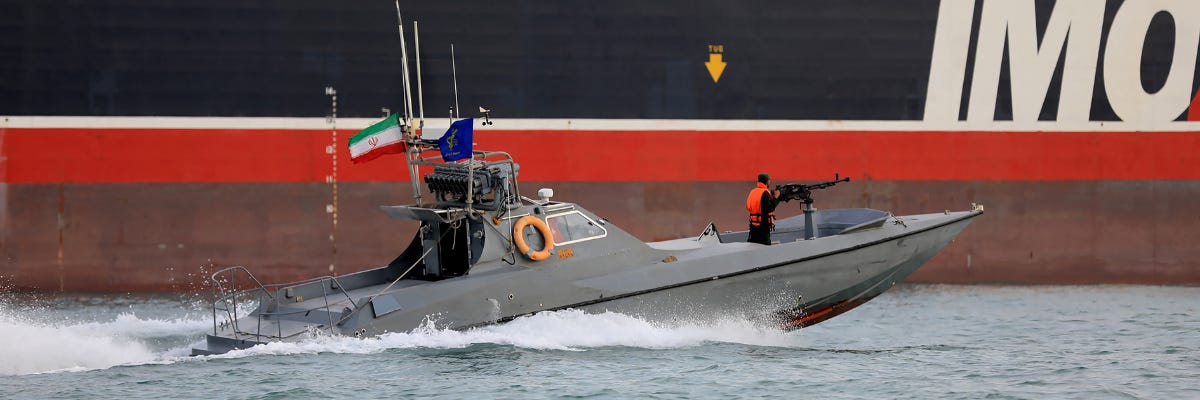
In either case, Iran will respond by trying to impose costs on the United States. A blockade is an act of war and Iranian authorities have vowed to retaliate against any such provocation. Of course, targeting U.S. forces directly is risky given that it could strengthen Trump’s resolve to wage a broader military campaign – Iran lacks escalation dominance. More likely, Iran will retaliate by trying to impose costs on the United States indirectly, targeting commercial vessels in the Gulf and thereby threatening major flows of goods and energy. Both Iran’s regular navy and the navy of the Islamic Revolutionary Guard Corps have spent the last four decades developing asymmetric naval weapons systems, such as small vessels armed with cruise missiles, that are designed to target larger vessels, whether military or civilian. Iran would likely use a combination of these assets, naval drones, and limpet mines, to target multiple commercial vessels as the blockade is enforced. A 2019 assessment of Iran’s military capabilities by the Defence Intelligence Agency notes that Iran’s “swarms of small boats, large inventory of naval mines, and arsenal of anti-ship missiles can severely disrupt maritime traffic.”
Iran has experience conducting asymmetric attacks in response to economic pressure. In 2019, Iranian oil exports plummeted due to the Trump administration’s maximum pressure sanctions. In response, Iran carried out two attacks. The first targeted oil tankers off the coast of Fujairah. The second targeted two major oil facilities in Saudi Arabia. By indicating the willingness to create collateral damage, Iran was able to increase the costs of the Trump administration’s policies, pushing policymakers Saudi Arabia and the United Arab Emirates to reevaluate to move towards normalizing relations with Iran as a means of managing tensions. Gulf leaders have recently been pressing Trump to avoid escalation with Iran because they understand that a military conflict could undermine not just regional security, but also regional and global prosperity.
Collateral Damage
American policymakers can weigh a blockade of Iranian ports because they face little direct dependence on the economies surrounding the Gulf. In 2024, the U.S. oil imports from the Gulf totalled just 500,000 barrels per day, less than a quarter of a percent of total U.S. oil consumption. Non-oil trade is also minimal. For example, the Gulf Cooperation Council (GCC) accounts for just 1.5% of total U.S. goods trade.
This lack of dependence contrasts sharply with the situation faced by China, which would be the major loser in any scenario where the Trump administration seeks to enforce a blockade on Iran. If the blockade is successful, China would lose access to around 20% of its crude oil imports, driving up the global price of oil as Chinese buyers seek alternative supply. In the medium-term China would likely purchase more oil from Russia, with counterproductive effects for enforcement of Russian oil sanctions. If the blockade does lead to broader disruptions to maritime trade, China would also face difficulties in sustaining exports not just to Iran, but also to the markets of the GCC and Iraq, which are the destination for around $160 billion of Chinese goods each year, or around 4% of China’s total exports.
Disruptions to routine trade, such as sourcing of Chinese goods, spells trouble for every economy in the Middle East and Central Asia given the growing dependence on China for everything from consumer electronics to industrial equipment. Iraq is especially vulnerable given its proximity to Iran. The river delta that leads to the Iraqi ports of Al Faw and Umm Qasr, which handle around 80% of Iraq’s total trade, lies just 75 kilometers from the bay that leads to Iran’s Imam Khomeini port. Vessel traffic moving to and from Iraq will be especially vulnerable to Iranian attacks.
For neighboring Kuwait, the prospect of disruptions in maritime traffic will bring back memories of the Tanker Wars, the name given to a series of nearly 500 attacks on merchant vessels that occurred during the Iran-Iraq War. The U.S. Navy eventually intervened to protect Kuwaiti oil tankers using convoys. Maintaining a blockade on Iran while also protecting civilian vessels poses a far greater challenge today.
Iran has too many targets in too small a space for U.S. forces to be able to provide definitive protection. Maritime traffic in the Gulf has skyrocketed since the Tanker War ended in 1988. Nowhere is this clearer than in the ports of the United Arab Emirates, which have become among the most active in the world. Total container traffic in the UAE was just 1.3 million twenty-foot equivalent units (TEUs) in 1988. Last year, total traffic in the UAE exceeded 21 million TEUs. Most of this traffic was centered on the port of Jebel Ali, which is the primary logistics hub for the GCC countries. These countries are served by feeder services from Jebel Ali, a vulnerability that was made especially clear in the case of the 2017 embargo of Qatar.
Both the price of oil and the cost of shipping result are determined in part by actuarial models, and this is what gives Iran the means to respond to an American naval blockade.
Along with the GCC, Iraq, and Iran, feeder services also connect Jebel Ali to the economies of Central Asia, mainly through the Iranian port of Bandar Abbas. Authorities in Uzbekistan and Kazakhstan, the two main Central Asian economies, have been seeking to diversify their dependence on Russian transport links since the 2022 invasion of Ukraine. Transport links through Iran are widely recognized as the most cost-effective option because they offer the shortest route to a major port. Sanctions imposed on Iran have prevented the full utilization of southern transport routes and Central Asian authorities have made efforts to boost trade through the so-called “middle corridor” to Europe that runs between the ports of Aktau and Baku. Central Asian authorities have also sought to develop a new southern corridor running through Afghanistan to the port of Gwadar in Pakistan. But dependence on the routes running through Iran persists. According to an analysis of data from 2023 prepared by the OECD, 19 million tonnes of freight passed through the three branches of the southern corridor, all of which run through southern Iranian ports.
Both the price of oil and the cost of shipping result are determined in part by actuarial models, and this is what gives Iran the means to respond to an American naval blockade. To impose indirect costs on the United States, Iran’s leaders merely need to increase the risk premiums related to maritime trade in the Gulf. The Houthis attacked just 30 commercial vessels in the Red Sea over a period of nearly two years, but the impact on global shipping costs was dramatic. Almost immediately, freight prices surged. The cost of shipping goods from Shanghai to Genoa more than tripled by the beginning of 2024, before settling to about double the pre-crisis average at the end of the year. It is also worth noting that U.S. forces performed poorly during Operation Prosperity Guardian, which sought to protect commercial vessels from the Houthi attacks in the Red Sea.
The impact of the Red Sea crisis on global growth and inflation was muted, largely because trade was able to divert to new routes and the crisis had a minimal impact on overall trade volumes. But a crisis in the Gulf would be different, impacting both the ability of energy supplies to reach the global market and the ability of large economies to source critical goods, throwing regional and global supply chains into disarray.
Esfandyar Batmanghelidj is the CEO of the Bourse & Bazaar Foundation and an Adjunct Professor at Johns Hopkins SAIS. He is a member of the Bologna Initiative for Sanctions Relief.
Section: (all-articles) Photo: IRNA